
Where Danville City Directories Are Held
Danville historical directory collections are spread across library holdings, microfilm, newspapers, clipping files, and reference sources. No verified official online catalog publishes an exact Danville publisher-by-year run, so the table separates confirmed local series from items that require a shelf check. Newspaper titles and dates are stronger than unverified directory assumptions. A household search should start with the era, then note whether the evidence is a printed name list, a street-ordered volume, or a source that supplies context.
| Collection | Years/content | Where held | Access |
|---|---|---|---|
| Danville Journal; Contra Costa Courier & Danville Journal | 1914 to May 11, 1918; May 31, 1918 to September 1930 | Walnut Creek microfilm; portions online | Online portions or in person |
| Valley Pioneer | 1954 onward; film March to August 1960 and January 1961 to August 1988 | Walnut Creek | Microfilm |
| Valley Times | NewsBank June 1995 onward; selected 1983 to 1986 film | Library database and Walnut Creek | Database or film |
| Danville clipping folders | People, schools, churches, structures, organizations, real estate and development, post office, and more | Contra Costa History Center | Catalog and research visit |
| Danville Voter List | 1871 | Contra Costa History Center | Archival access |
| City, telephone, and reverse directories | Exact Danville year-by-year run not published online | Library, Walnut Creek genealogy collection, and History Center | Ask a librarian |
| Sanborn maps | Exact Danville sheets not verified | Library of Congress and California libraries | Library inquiry |
Use a confirmed newspaper date as an anchor, then ask whether a library or archive holds a city, telephone, county, or reverse directory for the same period. The directory row is intentionally open about the gap. Research located county and San Ramon Valley runs, but not an official online list that proves each Danville publisher and year. That makes a title-page check important before citing a volume.
Danville's City Directory Newspaper Trail
Danville's newspaper record bridges a missing historical volume. The library lists Danville Journal from 1914 through May 11, 1918, then Contra Costa Courier & Danville Journal from May 31, 1918 through September 1930. Online portions cover May 31, 1918 through June 1922 and August 1922 through December 1923; Walnut Creek holds microfilm for the earlier run and the fuller 1918 to 1930 run. Valley Pioneer and Valley Times extend the trail later.
The historical newspaper holdings page is the source to check before choosing a date range or assuming that a search box covers every issue. A name search can find an obituary, society notice, real-estate item, or business mention, while browsing the page and date can rescue a surname missed by OCR.
The title change is local context as well as a search clue. Search “Danville” and “San Ramon Valley,” and preserve the issue date. A printed address or relationship still needs a directory or census check.
The historical newspaper holdings page supplies the source image for this Danville directory trail.
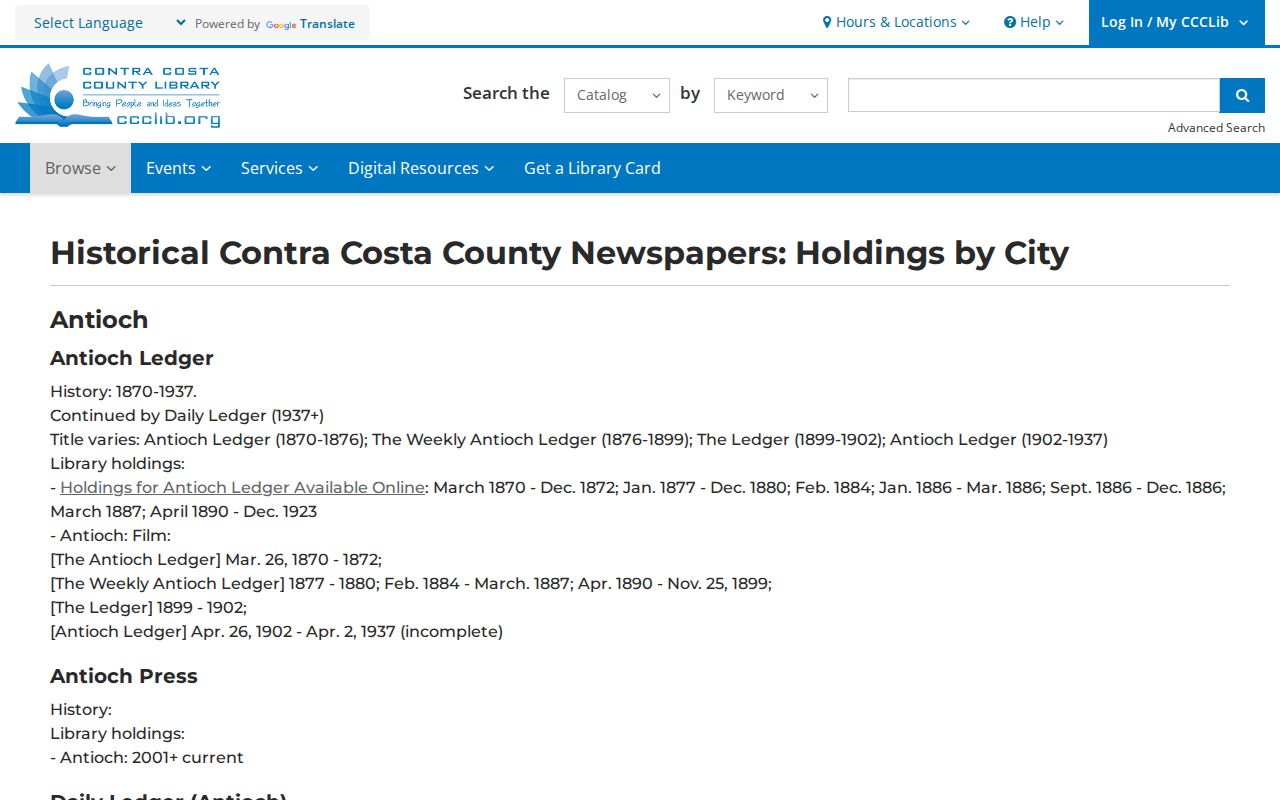
That visual record points back to the choice between online portions and Walnut Creek film, keeping the search tied to the actual collection.
How to Read a Danville Directory Entry
No official digitized Danville directory page with a viewable sample entry was located. The inventory below is therefore a field checklist, not a claimed transcription. Inspect the title page and the volume's own key before treating a mark as a fact. Publisher and year conventions can change, especially for owner or renter marks and street-order sections.
| Printed identity | Surname and given name or initials; a spouse may appear in parentheses. |
|---|---|
| Family clue | A widow notation such as “wid Charles” may identify a deceased spouse. |
| Occupation | Occupation and sometimes employer or work address. |
| Home address | House number and street; “r” generally means resides, not renter, unless the volume key says otherwise. |
| Owner or renter marks | Householder symbols and owner or renter marks vary by publisher and year. |
| Business listing | Business entries may be separate from household entries. |
| Abbreviation key | Photograph or transcribe the legend with the entry because conventions change. |
- Criss-cross directory
- A street-order section that lists people or households by address instead of only by surname.
- Householder index
- An alphabetical route into the person listed as the household head or primary entry.
- Abbreviation key
- The volume's legend for short forms, symbols, residence marks, and other local conventions.
Read a directory entry as a compact record with limits. An occupation can separate two people with the same name, while a spouse or address can connect a family across years. The entry still reflects what the publisher listed for that edition. Compare it with a census, newspaper, or deed before calling the person an owner or assuming every household member was included.
Danville Library Genealogy Help
Danville Library, at 400 Front Street, holds more than 72,000 items, six catalog computers, 33 public internet terminals, and Wi-Fi. One-on-one genealogy help comes through the San Ramon Valley Genealogical Society. That human channel helps when a directory search meets a missing year, hard-to-read scan, or surname variant.
The Danville Library databases page identifies Ancestry Library Edition and related census, vital, church, court, immigration, military, and directory collections. Ancestry is available inside a participating branch without a library card, and Send Document can transmit a discovery home. HeritageQuest is complementary where offered through the library account. Walnut Creek's genealogy collection is the county fallback when the Danville catalog is thin. The library database page is also the source for the image below.
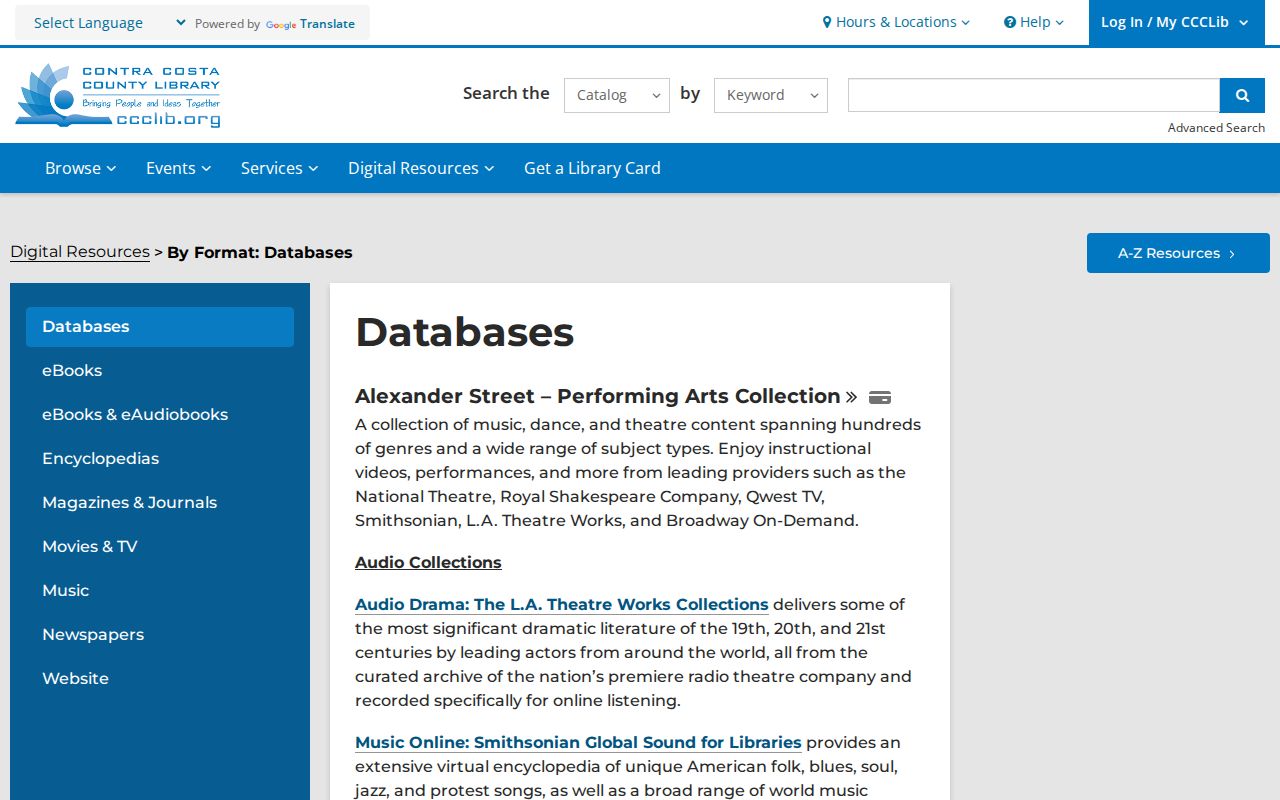
Use a branch database for a digital lead, then record the edition, page, address, and source before moving to print or microfilm.
Danville History Center Directory Files
The Contra Costa History Center adds context that a directory alone cannot supply. Its Danville files include people, schools and original school materials, churches, organizations, business, structures, real estate and development, government, the post office, the Railroad Museum, and a specific 1871 voter list. These folders can explain a name, street, subdivision, or institution in an entry.
The Contra Costa History Center is the manifest source for the local historical collection image.
The collection view reinforces searching by subject as well as surname. A real-estate folder may date a street's first appearance, while a school or church folder may separate people with the same initials.
The catalog's 1871 Danville Voter List is an unusual early named roll. It predates the newspaper run that begins in 1914 and can anchor a story from statehood-era county records to later local coverage. It is a historical source for adult voters tied to that community at that time, not a complete list of every resident.
School yearbooks, newspaper coverage, the Museum of the San Ramon Valley, and Tao House collections can add time and place, not current address proof.
A Danville Directory Timeline
Danville's record history is broader than the exact local directory run, but the sequence below shows when useful named sources appear. It also marks the jurisdiction change that affects how older material is found.
- 1850: Contra Costa County is one of California's original 27 counties, so recorder, court, and assessment series begin in the statehood era.
- 1871: The History Center preserves a specifically labeled Danville Voter List.
- 1914 to May 1918: The local newspaper appears as Danville Journal.
- May 1918 to September 1930: The title becomes Contra Costa Courier & Danville Journal.
- 1954 onward: Valley Pioneer holdings extend the local newspaper trail into the postwar period.
- 1982: Danville incorporates, creating a breakpoint between earlier county evidence and later Town records.
- 1995 onward: Valley Times appears in NewsBank, with additional film and paper holdings.
This is a source timeline, not a claim that 1914 was the first Danville directory year. The first exact publication date, publisher, and last printed year remain unverified, so a newspaper run should not be mistaken for a directory run.
Trace Danville Households Across Directory Years
Family-history work is clearer when a directory is treated as a snapshot and the federal census as a decennial checkpoint. Preserve the title page, edition year, page, address, and abbreviation key for each entry. These steps use local collections without claiming that a missing volume never existed.
- Start with a surname, address, or event; record married and birth surnames, initials, “San Ramon Valley,” and “Contra Costa.”
- Find the closest edition and note name, spouse or widow mark, occupation, and address.
- Follow nearby editions, recording moves, occupation changes, and first or last appearance.
- Use the criss-cross section for other listed people, then pair it with the nearest census through 1950.
- If someone or an address disappears, check newspapers, probate, cemetery, marriage, deed, or subdivision clues.
A disappearance may reflect a move, death, omission, an unavailable edition, or changed address wording. Census schedules show a checkpoint, while newspapers and probate can explain a later change. The Danville previous residents record path keeps ownership and occupancy separate.
Danville City Directory Search Clues
Names and places change shape across Danville records. Spanish-origin roads, compound surnames, initials, trusts, and family entities create variants. A newspaper may use a married surname, while a deed may use trustees or a trust name.
Early newspaper OCR can miss narrow columns. When a name fails, browse by date, address, street, or event. Try Hartz Avenue, Railroad Avenue, Front Street, Diablo Road, Camino Ramon, Sycamore Valley Road, Crow Canyon, Greenbrook, Tassajara, and Blackhawk. Search “San Ramon Valley” and “Contra Costa” with “Danville,” because older records may not use the modern postal city.
These clues make a directory search auditable without turning it into a complete residents list.
Danville's Unverified Directory Gaps
Several details remain research gaps. No exact Danville city or reverse-directory publisher and year run was verified online. No official digitized page supplied a viewable sample entry, and Danville-specific Sanborn sheet years were not confirmed. No recent official announcement confirmed Danville directory digitization or a townwide address realignment.
Use a focused access request, not a guessed date. Ask Danville Library staff or the San Ramon Valley Genealogical Society for a shelf check of city, telephone, county, reverse, or criss-cross volumes. Ask Walnut Creek about print and microfilm depth, and search History Center files for people, schools, real estate, post office, and structures. California State Library genealogy resources and the State Archives catalog can bridge a local gap.
The California State Archives is the source for the archives image and a useful catalog bridge for state government and transferred local-government material.
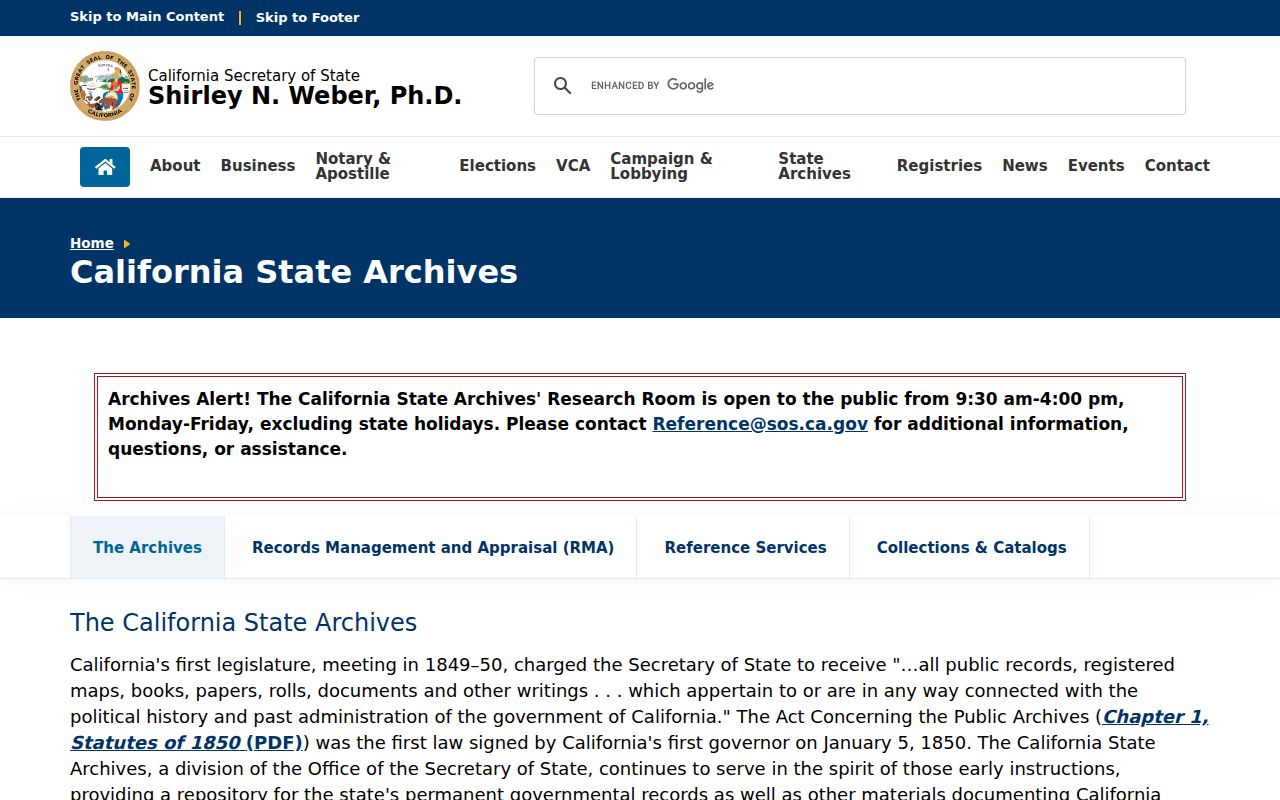
An archive catalog can point to a record family, but the collection description, access condition, and item reference still matter.
For current parcel context, use the Town's maps and GIS gateway. Keep older legal descriptions, subdivision names, and shelf details for the next record.